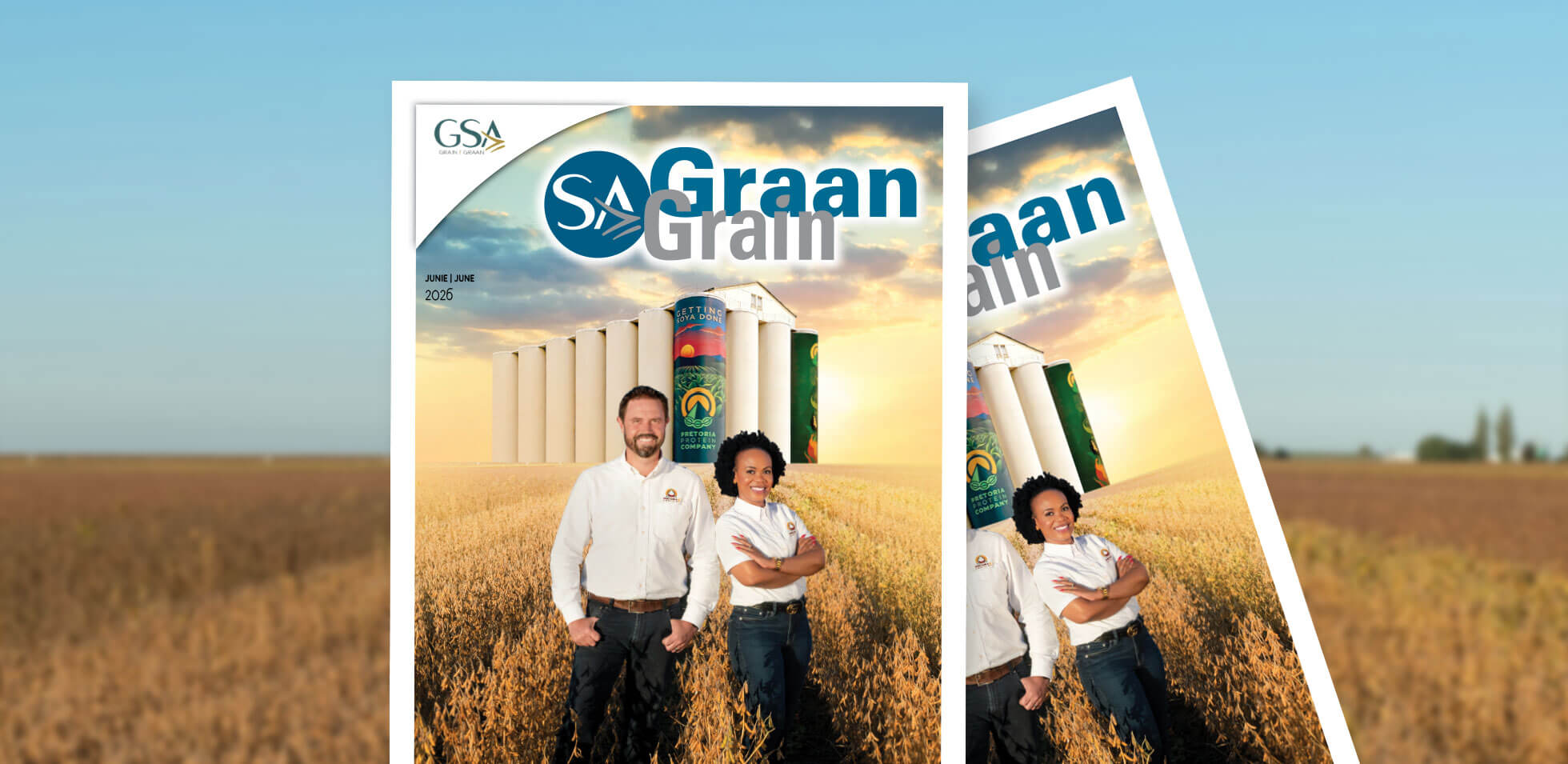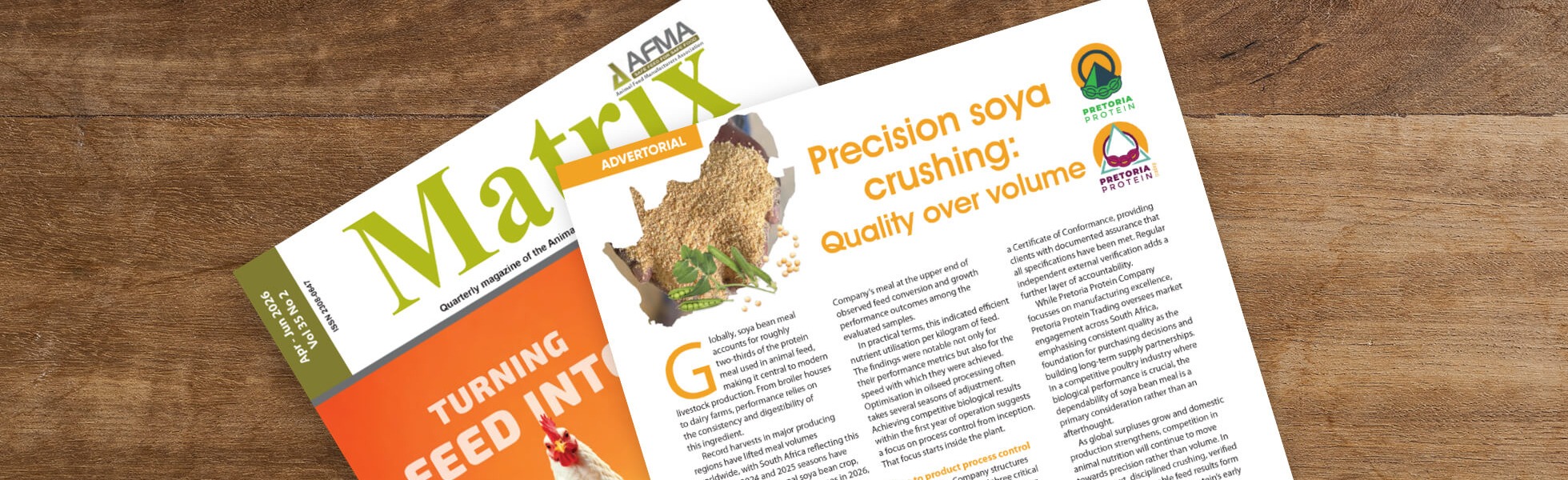
Published in AFMA Matrix, Apr-Jun 2026.
Globally, soybean meal accounts for roughly two-thirds of the protein meal used in animal feed, making it central to modern livestock production. From broiler houses to dairy farms, performance relies on the consistency and digestibility of this ingredient.
Record harvests in major producing regions have lifted meal volumes worldwide, with South Africa reflecting this trend. The 2024 and 2025 seasons have produced an exceptional soybean crop, with forecasts of 3.1 million tonnes in 2026, supported by favourable La Niña rains.
In these conditions, volume is no longer the differentiator. Quality is.
This shift comes as the local poultry industry reaches a new level of competitiveness. The BFAP 2025 Competitiveness Benchmark Report ranks the South African sector second globally, behind Brazil and ahead of the United States, on key production metrics and feed conversion among the world’s best. Feed accounts for roughly 70% of broiler input costs, with soybean meal as the primary protein source. In a system operating at such high biological efficiency and fine margins, small differences in digestibility or heat treatment can directly affect growth rates and feed conversion.
It is against this backdrop that Pretoria Protein Company, which began operations in October 2024, subjected its soybean meal to independent blind growth trials at the broiler research facility of Stellenbosch University. Birds were allocated to groups and fed identical diets containing soybean meal sourced from eight major suppliers. The results, published in Oilseeds Focus (Vol. 11, No. 4, December 2025), placed Pretoria Protein Company’s meal at the upper end of observed feed conversion and growth performance outcomes among the evaluated samples.
In practical terms, this indicated efficient nutrient utilisation per kilogram of feed. The findings were notable not only for their performance metrics but also for the speed with which they were achieved. In oilseed processing, optimisation often takes several seasons of adjustment. Achieving competitive biological results within the first year of operation suggests a deliberate focus on process control from inception.
That focus begins inside the plant. Pretoria Protein Company structures quality assurance around three critical points: the condition of the incoming bean, the discipline of processing, and verification before final release. This framework replaces assumptions with measurements throughout the process.
Quality is assessed upon the arrival of raw materials and throughout crushing and extraction, with laboratory testing embedded in daily procedures. Hourly analyses measure protein, fibre, fat, moisture, and urease activity, while physical factors such as cracked-bean size and flake thickness are also monitored because they influence extraction efficiency and the quality of downstream meals.
Heat treatment forms the central balancing act. Just enough heat is required to deactivate urease and other anti-nutritional factors; too much can impair amino acids and reduce digestibility. Real-time data interpretation by trained laboratory personnel allows adjustments before small deviations affect larger volumes. The process concludes with final batch approval and the issuance of a Certificate of Conformance, providing clients with documented assurance that all specifications have been met. Regular independent external verification adds a further layer of accountability.
While Pretoria Protein Company focuses on manufacturing excellence, Pretoria Protein Trading oversees market engagement across South Africa, emphasising consistent quality as the foundation for purchasing decisions and building long-term supply partnerships. In a competitive poultry industry where biological performance is crucial, the dependability of soybean meal is a primary consideration rather than an afterthought.
As global surpluses grow and domestic production strengthens, competition in animal nutrition will increasingly shift towards precision rather than volume. In that context, disciplined crushing, verified quality, and measurable feed results form a continuous loop. Pretoria Protein’s early trial results indicate that, in a market flooded with supply, careful processing remains one of the few benefits that cannot be commoditised.
Disclaimer: The trials were conducted independently at Stellenbosch University’s broiler research facility and published in Oilseeds Focus (Vol. 11, No. 4, December 2025). The publication does not endorse any supplier or product. The interpretation of the results presented here reflects Pretoria Protein Company’s analysis.
For further information or enquiries:
Pretoria Protein Trading
Tel: +27 12 004 3166
Email: info@pptd.co.za
Pretoria Protein Company
Tel: +27 12 004 1120